# Andreas Nicolas Fischer — full text > Berlin-based artist, creative technologist, creative director and founder working with generative systems, AI, realtime graphics and interactive environments. --- # Andreas Nicolas Fischer builds generative systems at the intersection of AI, computation and physical space. Artist · Creative Technologist · Creative Director · Founder. Works with generative AI, autonomous agents, realtime graphics, computer vision and interactive systems. --- ## Selected Work [![Graph view: six code-exploratory siblings of one parent, each rendered at 500 frames, one dotted exploration edge above them, with the inspector open](/images/projects/autonomous-generative-studio/hero.w960.0cd6c6cb.webp) Autonomous Generative Studio - A-GEN 2026 AI Agents · Evolutionary Systems · Generative Systems · three.js · Playwright ](/work/autonomous-generative-studio/)[![The LED wall seen from across the exhibition hall, its warm generative composition visible from the neighboring booths](/images/projects/cariad-volkswagen-iaa-2025/05.w960.4e350c72.webp) Volkswagen Group / CARIAD 2025 Realtime Graphics · Computer Vision · TouchDesigner · Python ](/work/cariad-volkswagen-iaa-2025/)[![Phygen's early interface showing a parent simulation, three agent-generated variants and the coding agent's explanation of its source changes](/images/projects/phygen/screenshots/12-recorded-feed.w960.b9872e39.webp) phygen 2026 Coding Agents · Evaluation Design · Creative Tools ](/work/phygen/)[![1275K Washington DC — Third Nature on the portrait LED wall in the building lobby, mirrored walls extending the generative garden](/images/projects/1275k-washington-dc/hero.w960.6ba3390a.webp) 1275K 2022 Realtime Graphics · Generative Systems · Computer Vision · TouchDesigner · SuperCollider ](/work/1275k-washington-dc/)[![anymator homepage — greeting and invitation videos for WhatsApp and social media, with a personalized video preview and customer reviews](/images/projects/anymator/hero.w960.0f975455.webp) anymator.de 2018–ongoing Generative Media · Product Design · Creative Technology · FFmpeg ](/work/anymator/) --- ## Current Research I am interested in systems where AI does not simply generate an output, but participates in the creative process: perceiving, reasoning, proposing, evaluating and modifying its own work. My current research explores autonomous agents, multimodal models, generative systems, realtime graphics and physical interaction — and what happens when these are composed into systems that develop their own creative judgment over time. --- ## About Andreas Nicolas Fischer is a Berlin-based artist, creative technologist, creative director and founder who has been building generative computational systems for 20 years. His practice spans software, screens, installations and architecture — from autonomous swarm-drawing algorithms to camera-tracked interactive environments and AI-driven generative pipelines. [Full bio →](/about/) --- ## Selected Clients - Hyundai - Volkswagen Group - CARIAD - Samsung - Audi - Mercedes-Benz - Hugo Boss - OPPO - Diesel - Time Warner --- # About Artist · Creative Technologist · Creative Director · Founder ![Portrait of Andreas Nicolas Fischer](/images/about/glitch.w960.28194071.webp) ![](/images/about/portrait.w640.65eec101.webp) Andreas Nicolas Fischer is a Berlin-based artist, creative technologist, creative director and founder working at the intersection of generative systems, artificial intelligence and physical space. Since 2008, he has built computational systems that generate, evolve and respond — across software, screens, installations and architecture. His practice is fundamentally interdisciplinary. He writes code, designs systems, produces artworks, and manages production — moving between the conceptual and the technical without treating them as separate domains. This range allows him to take projects from initial idea through research, prototyping, engineering and installation as a single continuous process. ## Practice Fischer's work centers on systems rather than fixed outputs. Rather than designing static images or sequences, he builds generative systems — rule-based algorithms, particle swarms, neural networks, camera-tracked interactive environments — that produce visual output continuously. The system's behavior over time is the work. His early Schwarm series (2012–2015) used autonomous drawing agents with rule-based behavior to compose abstract images from photographic palettes. Later works extended this into large-scale architectural installations (Hyundai Headquarters Seoul, 1275K Washington DC), camera-tracked interactive environments (Volkswagen Group / CARIAD at IAA Mobility 2025), and AI-driven pipelines (Autonomous Generative Studio - A-GEN). ## Current Focus His current research focuses on systems where AI participates in the creative process — not merely generating output from a prompt, but perceiving, reasoning, proposing, evaluating and modifying its own work. This includes autonomous agent architectures, multimodal perception models, and the integration of learned models into realtime generative pipelines. ## Background Fischer studied at the Berlin University of the Arts (UdK). He founded Studio A N F in 2008 as a vehicle for commissioned work in media architecture, interactive systems and generative design. Clients include Hyundai, Volkswagen Group, CARIAD, Samsung, Audi, Mercedes-Benz, Hugo Boss and others. ## Questions ### Who is Andreas Nicolas Fischer? Andreas Nicolas Fischer is a Berlin-based artist, creative technologist, creative director and founder. He has built generative computational systems since 2008, across software, screens, installations and architecture. ### What does he work on? Generative systems, AI agents, realtime graphics, computer vision and interactive environments — from permanent media architecture and camera-tracked installations to autonomous creative software such as A-GEN and phygen. ### Where is he based? Berlin, Germany. He works internationally on commissions, exhibitions and research collaborations, and founded Studio A N F in Berlin in 2008. ### How can I commission or contact him? For commissions, collaborations and research enquiries, use the contact address at the end of this page. ## Contact For inquiries, collaborations, or conversations about generative systems and AI: andreas \[at\] anfischer \[dot\] com Updated 21 October 2026 --- # Andreas Nicolas Fischer Artist · Creative Technologist · Creative Director · Founder Berlin, Germany andreas \[at\] anfischer \[dot\] com [anfischer.com](https://anfischer.com) [GitHub](https://github.com/anf6000) [LinkedIn](https://www.linkedin.com/in/anfischer) ## Profile Artist, creative technologist and creative director with 20 years of experience building generative, interactive and immersive systems. Works across generative AI, autonomous agents, realtime graphics, computer vision and creative coding, combining creative direction with hands-on technical development. Founded Studio A N F in Berlin in 2008. Work ranges from permanent media architecture and interactive installations to software products and experimental autonomous creative systems. ## Experience Studio A N F 2008–present Founder · Creative Director · Creative Technologist · Berlin Independent studio and artistic practice developing generative and interactive systems for physical environments, media architecture and digital experiences. - Creative and art direction - Generative system design - Realtime graphics development - Interactive systems and computer vision - AI-assisted and adaptive media - Technical prototyping and software development - Production and implementation - Direction of interdisciplinary teams and external partners Selected Projects [Hyundai Headquarters · Seoul](https://studioanf.com/project/hyundai-headquarters-seoul) 2026 Generative Media / Creative Technology Ultra-wide generative LED video installation for the central atrium of Hyundai Headquarters with other artists. Artwork produced by a generative system designed to continuously create evolving visual compositions. [Volkswagen Group / CARIAD · IAA Mobility Munich](https://studioanf.com/project/interactive-media-installation-for-cariad-vw-iaa-2025) 2025 Creative Direction / Generative Systems / Technical Development Interactive generative environment for a large-scale LED installation at IAA Mobility. Developed realtime graphics and interaction systems translating visitor movement captured by overhead cameras into continuously evolving visual behavior. TouchDesigner · Python · GLSL · Computer Vision [MIXC · Hangzhou](https://studioanf.com/project/mixc-media-facade-hangzhou) 2024 Generative Media Architecture Permanent architectural LED facade driven by a realtime generative particle system. [Longhua Hui · Shanghai](https://studioanf.com/project/longhua-hui-media-installation) 2023–2024 Generative Media Architecture Permanent synthetic landscape generated continuously in realtime rather than rendered as prerecorded content. Unreal Engine · Procedural Systems · Realtime Graphics [1275K · Washington DC, USA](https://studioanf.com/project/1275k-generative-realtime-art-installation) 2022 Generative Art / Interactive Systems Permanent installation comprising five realtime generative environments across a large architectural LED surface. Included interactive works using stereoscopic computer vision to translate visitor presence and movement into evolving particle systems. TouchDesigner · ZED Camera · Realtime Graphics [Samsung Electronics · IFA Berlin](https://studioanf.com/project/the-origin-of-the-quantum-dot-installation) 2016 Co-Art Direction / Media Art Co-art-directed The Origin of Quantum Dot, a large-scale spatial installation combining 45 displays, stained glass, light, sound and moving image. Collaboration with Schnellebuntebilder, Christopher Bauder / WHITEvoid and kling klang klong. Agency was Cheil. [Diesel Flagship Store · Rome](https://studioanf.com/project/thoughts-of-rome-realtime-installation) 2014 Generative / Interactive Environment Created an immersive realtime digital environment distributed across 65 LED displays for Diesel's Piazza di Spagna flagship as collaboration with Abraham Pazos. The generative system reacted to online activity around Rome and the #POSTRoma campaign. Selected Clients Hyundai · Volkswagen Group / CARIAD · Samsung Electronics · Audi · Mercedes-Benz · Hugo Boss · Diesel · OPPO · Time Warner ## AI and Autonomous Systems Autonomous Generative Studio - A-GEN 2026–present Experimental autonomous creative system exploring collaboration between human artistic direction and AI agents. The system enables agents to: - Generate artistic concepts - Write and modify creative code - Produce and evaluate visual output - Branch into alternative creative directions - Compare and discard iterations - Preserve creative lineage and decision history Research areas include autonomous agents, multimodal evaluation, agentic coding, generative systems and human–AI creative collaboration. Generative AI / Computer Vision Research 2023–present Independent research and production work across: - LLM agents - Multimodal and vision-language models - Diffusion models - Image-to-image systems - ControlNet and structural conditioning - Generative video - Computer vision - Local LLMs - AI-assisted software development - Realtime AI integration PyTorch · Transformers · ComfyUI · OpenCV ## Entrepreneurship anymator 2018–ongoing Co-founder · Product / Creative Technology Co-founded and bootstrapped a browser-based software platform for creating and distributing personalized motion graphics and digital postcards. Developed from a consumer motion-design tool into a white-label B2B product for tourism and hospitality. Responsibilities include: - Product concept and strategy - Creative direction - UX and interaction design - Generative media systems - Frontend development - Rendering pipeline prototyping - B2B product development - Customer pilots and iteration Scaled to 250,000+ users, with hundreds of thousands of generated designs. FFmpeg · Blender · JavaScript / React · Ruby on Rails ## Artistic Practice Media Artist 2006–present Independent artistic practice investigating autonomous generative systems, computation, emergence, simulation and the translation of digital processes into physical and audiovisual experiences. Early work explored computational data sculpture and custom generative software before expanding into realtime installations, moving image, media architecture and autonomous systems. Selected Works - [Schwarm](https://studioanf.com/project/schwarm-generative-artwork) - [KARST](https://studioanf.com/project/karst-generative-landscapes) - [Spectral Density Estimation](https://studioanf.com/project/spectral-density-estimation-data-sculpture) - [Second Nature](https://studioanf.com/project/second-nature-video-installation) - [Computer Visions](https://studioanf.com/project/computer-visions-video-art) - V0ID - [Hyperschwarm](https://studioanf.com/project/hyperschwarm-generative-art-installation) - Nethervoid - Infinite Void Selected Exhibitions - Today Art Museum, Beijing - Nederlands Instituut voor Mediakunst, Amsterdam - LABoral, Gijón - SECCA, USA - HEK Basel - Austrian Film Museum - FILE São Paulo - Kiasma Helsinki - Centro Banco do Brasil, Brasilia ## Selected Talks D&AD / The Future Laboratory · London 2015 Awakening Tech — speaker alongside Quayola and Lawrence Lek FIBER / MU · Eindhoven 2014 Coded Matter(s): Transmaterials — speaker alongside Quayola and Ann-Sophie Lehmann Scope Sessions · Berlin 2012 Schwarm — artist talk on autonomous generative software Berlin University of the Arts Legacy Lectures — invited speaker ## Selected Interviews and Press LED.ART Magazine 2026 Artist interview Niio Editorial 2022 Long-form artist interview VICE / The Creators Project 2012 Interview Seeing/Knowing — Graham Gund Gallery 2011 Interview Cool Hunting 2009 Feature Additional coverage includes Vogue Italia, Numéro, CreativeApplications.Net, IGNANT, Designcollector and Artribune. ## Selected Publications - Digital Art — Wolf Lieser - Data Flow II — Robert Klanten, Nicolas Bourquin, Thibaud Tissot et al. - Generative Gestaltung — Hartmut Bohnacker, Benedikt Groß, Julia Laub, Claudius Lazzeroni - Data Flow — Robert Klanten, Nicolas Bourquin, Thibaud Tissot et al. ## Education Berlin University of the Arts 2006–2008 Dipl.-Des. (Master of Arts equivalent) Digital Media class of Prof. Joachim Sauter and Prof. Jussi Ängeslevä. Hochschule für Gestaltung Schwäbisch Gmünd 2003–2005 Graphic Design studies ## Technologies AI / ML LLM agents · Multimodal models · Diffusion · PyTorch · Transformers · ComfyUI Realtime / Graphics TouchDesigner · GLSL · Three.js / WebGL · Unreal Engine Engineering Python · JavaScript · OpenCV · FFmpeg · Git / Linux ## Languages German — Native English — Fluent Portuguese — Fluent Spanish — Conversational French — Conversational ## Questions ### What is Andreas Nicolas Fischer's background? He studied Digital Media at the Berlin University of the Arts (Dipl.-Des., 2006–2008) and graphic design at Hochschule für Gestaltung Schwäbisch Gmünd (2003–2005), and founded Studio A N F in Berlin in 2008. ### How can I commission or contact him? For commissions, collaborations and research enquiries, write to the contact address in the CV header. Updated 21 October 2026 --- # Work Five projects across permanent installations, media architecture and generative software. Each page documents the system behind the work: the inputs, the constraints, the infrastructure and what it took to keep it running. Generative systems · Media architecture · Realtime graphics · AI --- ## Selected projects [![Graph view: six code-exploratory siblings of one parent, each rendered at 500 frames, one dotted exploration edge above them, with the inspector open](/images/projects/autonomous-generative-studio/hero.w960.0cd6c6cb.webp) Autonomous Generative Studio - A-GEN 2026 AI Agents · Evolutionary Systems · Generative Systems · three.js · Playwright ](/work/autonomous-generative-studio/)[![The LED wall seen from across the exhibition hall, its warm generative composition visible from the neighboring booths](/images/projects/cariad-volkswagen-iaa-2025/05.w960.4e350c72.webp) Volkswagen Group / CARIAD 2025 Realtime Graphics · Computer Vision · TouchDesigner · Python ](/work/cariad-volkswagen-iaa-2025/)[![Phygen's early interface showing a parent simulation, three agent-generated variants and the coding agent's explanation of its source changes](/images/projects/phygen/screenshots/12-recorded-feed.w960.b9872e39.webp) phygen 2026 Coding Agents · Evaluation Design · Creative Tools ](/work/phygen/)[![1275K Washington DC — Third Nature on the portrait LED wall in the building lobby, mirrored walls extending the generative garden](/images/projects/1275k-washington-dc/hero.w960.6ba3390a.webp) 1275K 2022 Realtime Graphics · Generative Systems · Computer Vision · TouchDesigner · SuperCollider ](/work/1275k-washington-dc/)[![anymator homepage — greeting and invitation videos for WhatsApp and social media, with a personalized video preview and customer reviews](/images/projects/anymator/hero.w960.0f975455.webp) anymator.de 2018–ongoing Generative Media · Product Design · Creative Technology · FFmpeg ](/work/anymator/) --- # Experiments Three systems built around a specific technical question: how to keep a generative process inspectable once it starts producing work. Each entry pairs a short account with evidence from the build. Updated 21 October 2026 --- 01 ## Kiloskin / Agents at Work Agent runtime · Electron · SSE + SQLite Kiloskin is a desktop client for the Kilo agent runtime. The Electron main process resolves and spawns kilo serve, holds the server password, reads files and normalises HTTP and SSE events into one store; the React renderer only draws snapshots received over IPC. Chat, live code, terminal output, diffs, plans and permission requests become separate panes fed by the same event stream. The difficult part is synchronisation. Two Kilo servers, one in this app and one in VS Code, each have their own SSE bus, so neither sees the other's activity. Both read the same SQLite database. The bridge reconciles roster, transcript and diffs against it every 1.5 seconds, while local activity still arrives immediately. It is legible, not magical. ![Kiloskin Minimal layout: chat at left, a pending edit to TerminalPane.tsx at top right, and a read-only terminal panel below it.](/images/experiments/kiloskin/layout-minimal.w960.7233412b.webp) _Minimal layout / chat, live edit and read-only terminal in one window; edit permission still running. Demo workspace with sample data. [Full size: Kiloskin Minimal layout](/images/experiments/kiloskin/layout-minimal.webp)_ ![Kiloskin Mission Control layout: three agent cards labelled Code, explore and code-reviewer above activity, plan and approval panels.](/images/experiments/kiloskin/layout-mission.w960.5c8c638c.webp) _Mission Control / three agents, activity trace, plan and a human approval request in one grid. Demo workspace with sample data. [Full size: Kiloskin Mission Control layout](/images/experiments/kiloskin/layout-mission.webp)_ ![Kiloskin Focus layout: a single chat pane with an edit status, and tabs for code, terminal, agents, diffs, thinking, timeline, signal, plan and approvals.](/images/experiments/kiloskin/layout-focus.w960.d4678242.webp) _Focus layout / one conversation, with every other pane reduced to a tab. Demo workspace with sample data. [Full size: Kiloskin Focus layout](/images/experiments/kiloskin/layout-focus.webp)_ 02 ## Self-Evolving Life GLSL evolution · Novelty search · Vision judging Self-Evolving Life treats a cellular automaton as a search space of executable shaders. A language model proposes changes to the step and display fragments; repair fixes missing uniforms and syntax before compilation, and runtime gates reject anything that fails, freezes, goes blank or exceeds a time budget. Survivors are fingerprinted by behaviour, not code: sparseness, motion, entropy, hue, saturation and texture frequency drive novelty search. A vision model watches five frames rather than one still, so it can distinguish structure from fizz; a measure tests how much variance survives block averaging. Every genome is stored in IndexedDB, so lineage can be inspected and replayed. Judgement is a proxy, not solved taste. The engine builds on skeeto's WebGL Game of Life. ![Self-Evolving Life cloud view: a dense constellation of genome nodes across generations, with a pink cellular-automaton canvas and code, rationale and judge panels.](/images/experiments/self-evolving-life/cloud.w960.4bb15d26.webp) _Cloud view / 50 genomes after a ten-minute local run on qwen2.5-7b-instruct. Forty-eight failed compilation, runtime or novelty gates; one mutation survived. [Full size: Self-Evolving Life cloud view](/images/experiments/self-evolving-life/cloud.webp)_ ![Self-Evolving Life tree view: a short accepted lineage of genome nodes linked by generations, beside the selected genome's shader code and rationale.](/images/experiments/self-evolving-life/tree.w960.64a5156f.webp) _Tree view / accepted lineage only. One child survived at generation 1 with a novelty score of 4.74. [Full size: Self-Evolving Life tree view](/images/experiments/self-evolving-life/tree.webp)_ ![Detail of the generation-zero seed: pink and white cellular-automaton clusters on a white field.](/images/experiments/self-evolving-life/seed-detail.w960.4e388a81.webp) _Seed detail / crop from the 1024 px generation-0 still. The surviving child was not saved at full resolution. [Full size: Detail of the generation-zero seed](/images/experiments/self-evolving-life/seed-detail.webp)_ Engine based on [skeeto/webgl-game-of-life](https://github.com/skeeto/webgl-game-of-life) (Unlicense). 03 ## Single Column / FFFFOUND! Found images · AI upscale · Sampled mattes Single Column is a small FFFFOUND! reader built around 231 AI-upscaled images. Every seven seconds it rescans the folder and appends anything new. Modern mode shows one image at a time against a mat colour sampled from the file itself; classic mode restores the dense masonry grid, and a local flag remembers the choice. The source files are z-image upscales of found photography and renderings, enlarged for screen display rather than restoration. I did not take the photographs. The experiment is about rhythm and framing: how much context an image needs, how a sampled border changes its reading, and whether a feed can feel edited without a human editor. Nothing is captioned or tagged. Copyright remains with the original authors. ![Single-column image view: a wide photograph of a grassy, rocky clearing set inside a large olive-grey mat, with a mode button at the top right.](/images/experiments/found-upscale/single-column-matte.w960.6bc82a4b.webp) _Single-column mode / one image per view, mat colour sampled from the file. Browser capture, 20 Oct 2026. [Full size: Single-column view, matte frame](/images/experiments/found-upscale/single-column-matte.webp)_ ![FFFOUND! classic mode: a four-column masonry grid of found images with filenames, beneath a black FFFFOUND! logo.](/images/experiments/found-upscale/single-column-classic.w960.ac47f3a0.webp) _Classic mode / 231 upscaled WebPs in the original masonry density. [Full size: FFFOUND! classic mode](/images/experiments/found-upscale/single-column-classic.webp)_ ![Single-column image view: a portrait of a person among large leaves, set inside a pale grey sampled mat.](/images/experiments/found-upscale/single-column-portrait.w960.62c9bd1e.webp) _Sampled matte / the border follows the image, not a fixed theme. [Full size: Single-column view, portrait crop](/images/experiments/found-upscale/single-column-portrait.webp)_ Source images are from the FFFFOUND! archive and remain the property of their original authors. The upscaled files are shown for display only. --- # Autonomous Generative Studio - A-GEN A local agent-driven evolutionary studio in which model agents propose bounded mutations to a seeded, frame-driven particle painting and a human selects which versions survive. Part artwork, part technical documentation of an evolvable image system. ## Key facts - **Year:** 2026 - **Role:** Concept, system design, development - **Tools:** AI Agents, Evolutionary Systems, Generative Systems, three.js, Playwright

A-GEN_01 · Evolutionary Studio · Technical Documentation

## Technical images under human selection A local agent driven studio in which a seeded, frame-driven particle painting is evolved by model agents and a human breeder.

Part I — The artistic concept

## An evolutionary studio for technical images ### 1 · The apparatus and its program A_GEN_01 is a particle painting. Tens of thousands of particles wander a field built from two noise functions — Perlin and curl — and deposit pigment on an accumulation buffer, frame after frame, until the painting is finished. Nothing in the picture is drawn by hand. Every mark is a consequence of a program: a seeded random generator, a fixed noise implementation, a configuration that names the field scales, the particle lives, the color cycle. Vilém Flusser called images like this *technical images*: images produced by apparatuses rather than by hands. For Flusser, a photograph is not a window onto the world but a projection of a concept onto the world — the camera realizes possibilities that were latent in its program. A_GEN_01 makes that latency explicit. Its program is literally readable: `config.json` is the parameter surface of the apparatus, the code is its fixed part, and the seed is the throw of the dice that starts it. Where a photographer walks the world looking for scenes, this apparatus walks its own possibility space. Every seed, every field scale, every lifespan is an address in a landscape of possible paintings that exists before anyone looks at it. ### 2 · The artist as selector An apparatus contains more possibilities than any player can visit. Flusser's player is the one who probes the program, hunting for the improbable — for states the program contains but rarely shows. In this studio the exploration is shared. Model agents propose mutations — parameter shifts, focused code changes, open explorations — inside hard bounds. But they never judge. No fitness function ranks the children. The only aesthetic act in the system is selection: the artist looks at renders and chooses which versions survive as parents. This puts the studio in an old lineage. Richard Dawkins' biomorphs showed that a blind mutation walk becomes directed the moment an eye picks a branch. Karl Sims evolved virtual creatures by jury; William Latham grew sculptures by hand-picking mutations. In all of these, evolution is not automatic — it is a dialogue between a generator that can only enumerate and a selector that can only choose. The computer explores; the artist is the fitness function. The studio enforces this in code: an unselected version is not rejected, it simply waits; and nothing evolves without a new, confirmed human request. The machine proposes, the human disposes — and the proposing is bounded so that the disposing stays meaningful. ### 3 · Breeding: every child descends from both parents One source produces variants of itself. But when the artist selects a second source, the pair is *bred*: every candidate of that round is then a hybrid of *both* parents, not a share of each. This is the rule that makes the crossing a real cross and not a collage. Two kinds of hybrid exist, and the difference matters. A **parameter hybrid** is computed by the studio itself: the two genomes cross field by field, each field taken from one parent or the other. No model is called, no judgment is involved — the cross is arithmetic, and the provenance records exactly which field came from which parent. A **code hybrid** is synthesised by one worker that is given both sources, one of them read-only: two programs enter, one program leaves, and the child must carry the character of both. In both cases the parents are recorded, the inherited fields are listed, and a hybrid remains *one seeded artwork* — two sources can only be bred when they share one seed and one resolution, because the child replays from a single seed at frame zero. Crossing is never automatic. It happens only where the artist selected two sources, the way a breeder chooses a pairing for traits already seen. The offspring is a descendant of both — a new point in the program's possibility space that neither parent could reach alone. The hybrid is therefore not just a visual mixture. It is a relation between two programs. One source contributes a way of moving, coloring, or accumulating; the other changes the field in which those behaviors become visible. The child is a new operation on the same seeded material, and its difference from each parent can be inspected rather than guessed from the image alone. ### 4 · The lineage as artwork The studio's real output is not any single painting. It is a lineage of technical images: a family tree in which every edge is a recorded decision and every card keeps its render, prompt, diff and failures. The graph is not a diagram placed around the artwork after the fact. It is a second surface of the work. It shows how visual form becomes history. This is close to Gilbert Simondon's idea that a technical object is understood through its becoming, not only through its finished shape. Each version carries traces of the conditions that produced it: the parent or parents, the selected render, the worker assignment, the actual diff, and the point at which the artist accepted or passed over it. The object is not isolated from its history. Its history is part of what it is. The interface gives that history a readable form. Graph makes relations visible. Compare makes differences visible. Inspector makes causes visible. Together they turn an otherwise hidden program into a space the artist can inhabit and question.
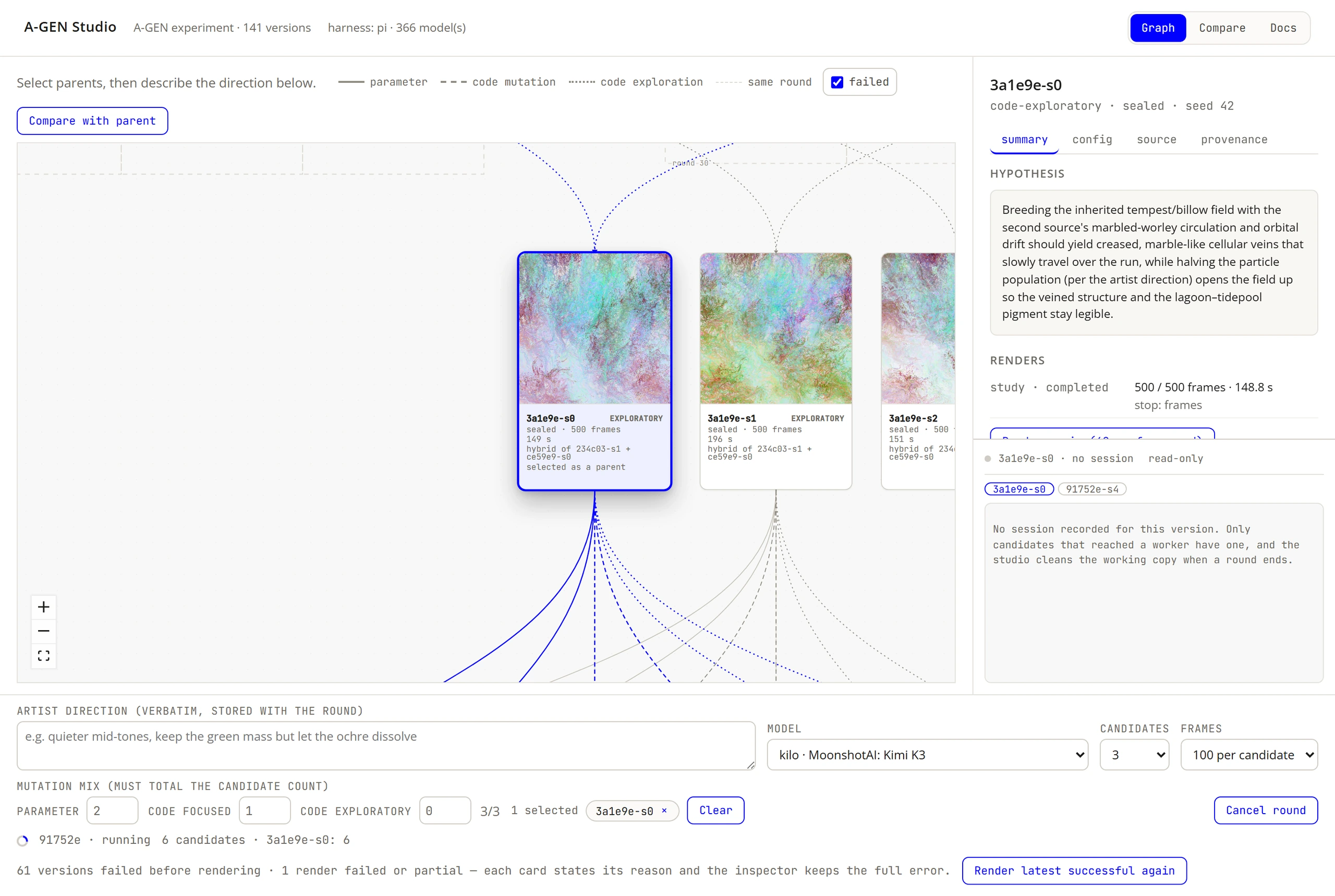
Graph view: a selected sealed version with its hybrid lineage and the inspector open
Fig. 1 — The lineage, visible. A sealed code-exploratory version is selected as a parent (blue card) and its hybrids are grouped beneath it: siblings sharing a parent set sit together, solid edges for parameter mutations, dashed for focused code mutations, dotted for explorations. Every card is a real render or an honest state — queued, in progress, failed — never a placeholder pretending to be work.
### 5 · Determinism and the improbable Every version is frozen: source, configuration, ordered textures, seed — hashed and kept. A render is a fixed number of frames computed from that frozen state, not a duration; a replay walks from frame zero to the recorded frame. The image is therefore a calculation that can, in principle, be repeated — the projection surface is documented along with the projected image. The archive also keeps what did not survive. Failed versions sit in the graph beside the sealed ones, each stating its reason; a rejected submission and its repair remain inspectable as evidence. Flusser worried that technical images would become a memoryless flow. This studio's answer is an append-only memory in which the improbable path through the program — including its dead ends — stays visible. The project is close to Sol LeWitt's idea that a concept can become a machine that makes the art, but it keeps the machine open to human interruption. The program proposes; the artist chooses; the archive remembers both actions.

Part II — Technical documentation

## How the studio works ### 1 · Three parts
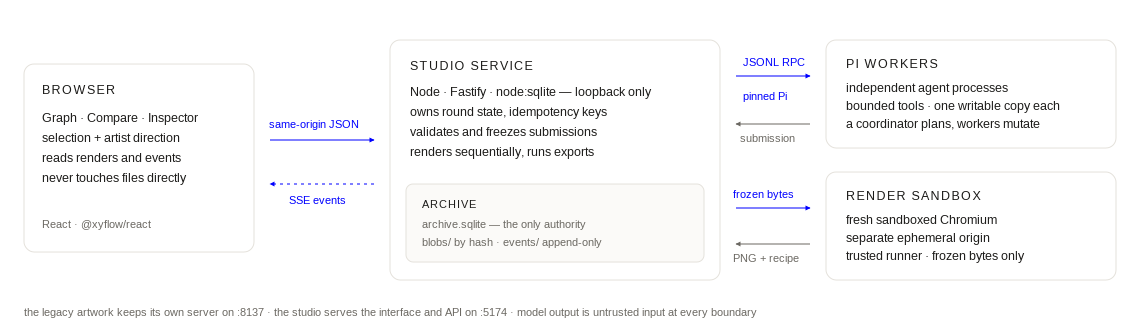
System overview: browser, studio service, workers and render sandbox
Fig. 2 — Three parts. The browser only speaks to the studio service; the service owns all state. Workers never see the browser, and the render sandbox never sees the studio's data beyond the frozen bytes of one candidate.
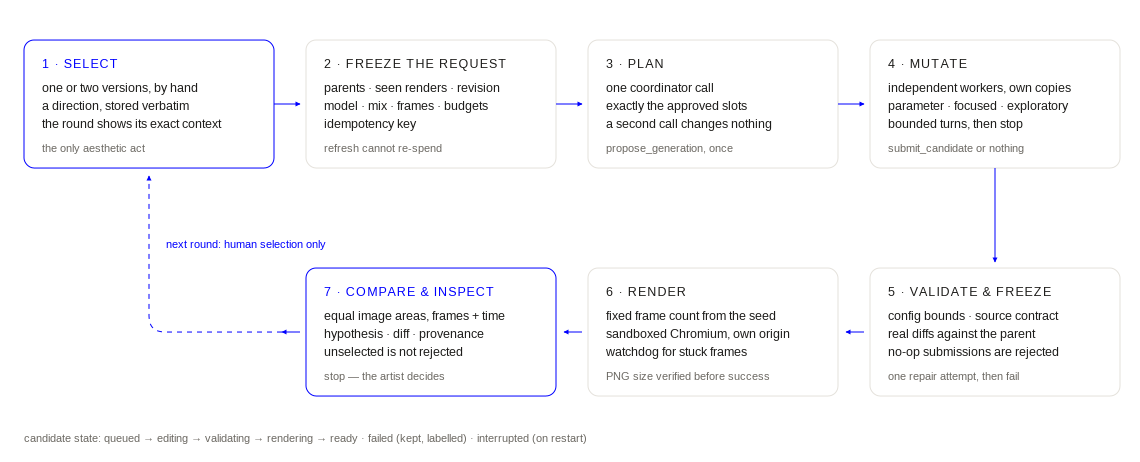
### 2 · The artwork and its contract The artwork is the existing three.js port of the Processing sketch `A_GEN_01.pde`. It is bit-exact against Processing at seed 42. The studio does not rewrite it; it drives it and mutates copies of it. Three rules make that safe: - **Seeded.** One number (seed 42, inherited by every version unless the artist changes it explicitly) drives a 48-bit LCG and the noise functions. Same seed, same bytes, same painting. - **Frame-driven.** The simulation advances by calling `step()` and drawing once per frame. No wall-clock time enters the artistic state, so a render is defined by a frame count, not by a duration. - **Config-driven.** Everything that changes the look lives in `config.json`. The studio imports those bytes, hashes them, and treats them as the genome. ### 3 · The genome The genome is the config: six fixed sections plus a free `custom` namespace that code workers may add to. The studio knows which fields can change pixels and within which ranges — fields marked inactive exist in the config but do not move pixels today (for example `canvas.background`, which the renderer ignores). Parameter workers may only edit active fields. | Section | Fields | Notes | | --- | --- | --- | | `run` | `seed · frames · width · height · speed` | seed and resolution are locked unless the artist changes them | | `particles` | `amount · maxParticles · strokeWeight · opacity · speed · noiseOffset` | amount is capped by maxParticles | | `flowfield` | `perlinNoiseScale · curlNoiseScale · curlMix` | the two noise fields and their mix | | `life` | `baseLifespan · lifespanJitter · finalColorInfluence · initialColorInfluence` | particle lifetime and color blend over life | | `sequence` | `timer · amtTex · zoomAmount` | texture swap cadence and zoom | | `canvas` | `background · cap · hud` | background inactive today; hud is a DOM overlay, never captured | | `custom` | `data only` | code workers may extend; the studio keeps it, warns on unknown fields | ### 4 · One round A round is one confirmed request from the browser. It is frozen before anything runs: parents, the exact renders the artist saw, the verbatim prompt, the model, the mutation mix, the frame count and the budgets. An idempotency key makes retries safe — a refresh cannot start a second round or spend twice.
The seven stages of a round, from selection to comparison, with the human feedback loop
Fig. 3 — One round. The request is frozen before work starts; workers get their own copies; validation and freezing produce immutable versions; rendering uses only frozen bytes. The loop back to stage 1 is human — the studio never starts a round by itself.
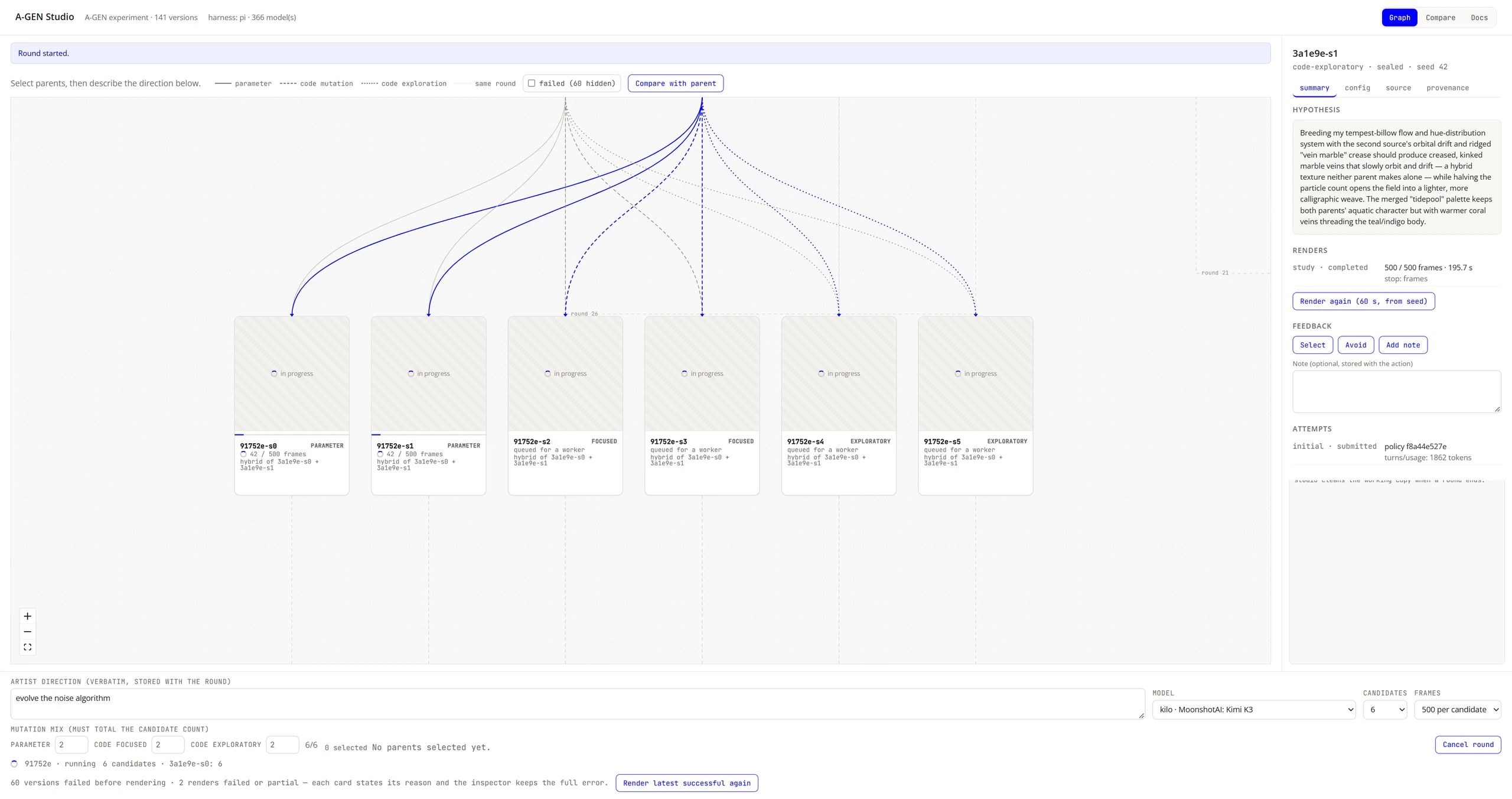
A running round of six hybrid candidates with one sealed sibling open in the inspector
Fig. 4 — The same round, running. Six hybrids of one pair (2 parameter, 2 focused, 2 exploratory) work in parallel — two queued, four in progress — each in its own workspace. The inspector holds a sealed sibling's hypothesis and provenance while the others work, and the bar shows the mutation mix, which must total the candidate count.
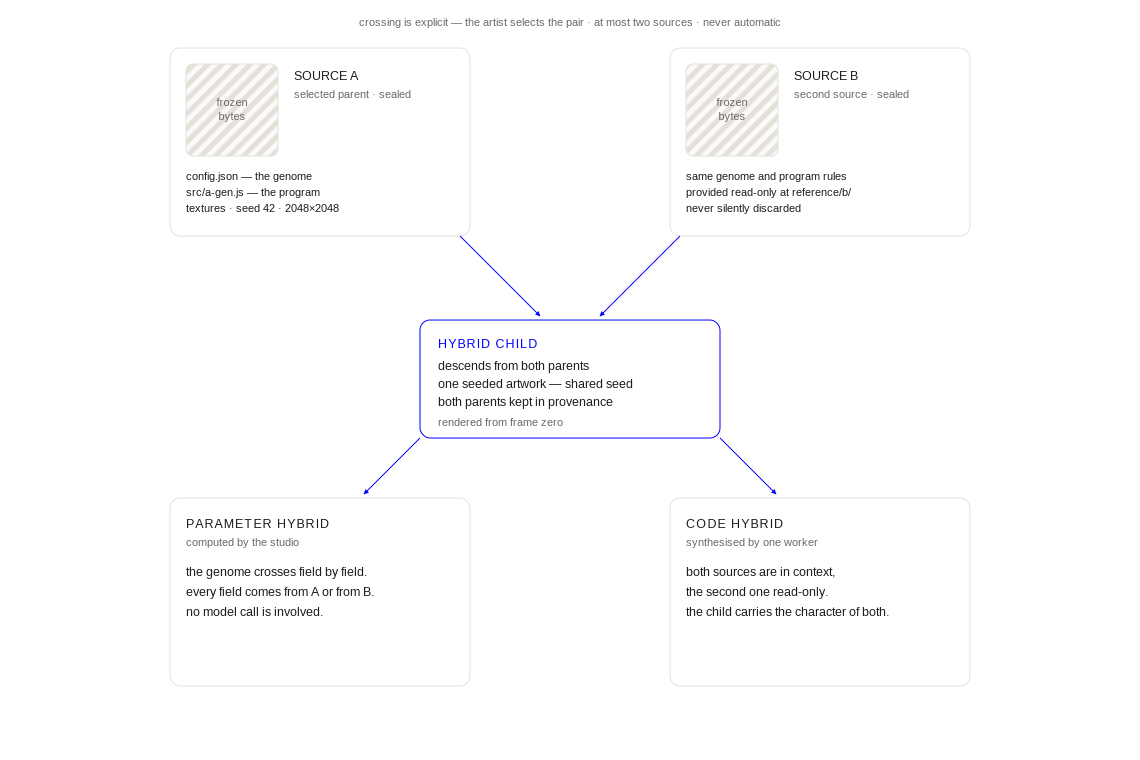
| Default | Value | Note | | --- | --- | --- | | `candidates` | `3 (max 9)` | mix must total the candidate count | | `mutation mix` | `2 parameter · 1 code focused` | code exploratory replaces focused for open directions | | `parents` | `1–2` | two sources are bred, see §5 | | `frames` | `100 (options 100 / 200 / 500)` | an exact frame count beats a duration | | `watchdog` | `75 s` | external, for stuck frames and stuck workers | | `worker turns` | `8 by mode (more for code exploration)` | a turn is one model round-trip | | `repair attempts` | `1` | the failure reason is quoted back to the worker | | `models` | `366 available via Pi` | chosen in the UI per round; never silently substituted | ### 5 · Breeding two sources With one selected parent, the candidate count is divided across that parent: each candidate is a variant of it. With two selected parents, the studio breeds the pair instead — every candidate of the round is a hybrid of both. Two sources must share one seed and one resolution, because a hybrid is one seeded artwork, not a collage of two.
Breeding: two sources converge into one hybrid child, via a studio-computed parameter cross or a worker-synthesised code hybrid
Fig. 5 — Breeding. The graph draws two arrows converging on every hybrid; the inspector lists both parents and which fields were inherited from the second source.
The two kinds of hybrid differ in an important way. The parameter hybrid is mechanical — the studio performs the cross itself, so the result is exactly the arithmetic and nothing else; no model is called and no taste is involved. The code hybrid is a synthesis: a worker reads both programs and writes one that keeps the seeded, frame-driven contract while carrying both parents' character. In both cases the artist chose the pair, and the record shows the cross field by field or the actual source diff. ### 6 · The worker sandbox Each candidate gets an isolated working copy of its parent's frozen bytes. A worker agent never sees the studio, the browser, the network, or another worker's copy. It has six tools and nothing else — no shell, no filesystem outside its copy, no package installation. Completion requires a structured submission, never an assistant message. | Tool | What it may do | | --- | --- | | `list_artwork` | see the files of its working copy | | `read_artwork` | read allowed paths (its own editable files plus the read-only second source) | | `patch_artwork` / `replace_in_artwork` | edit `config.json`, `src/a-gen.js`, `src/renderer.js` — and, for code work, add bounded helper modules under `src/` | | `validate_artwork` | pre-check its own work against the seal-time rules | | `submit_candidate` | submit hypothesis, intended changes, and the edited files — once | Enforcement lives in the extension, not in the model: resolved-path containment (traversal, UNC paths and symlinks are rejected), mutation-mode allowlists, a 256 KiB source quota, at most 12 files, 64 KiB tool results, and static import checks (only `three` may be imported; the parser is a real ES-module parser, nothing is executed). Parameter workers cannot edit JavaScript at all — the freeze compares file hashes. ### 7 · Validation, freezing, repair When a worker submits, the studio — never the model — decides what happens. The config is resolved against known bounds (a field outside its range is an error; the legacy numeric `canvas.hud` written by an earlier validator version is resolved back to its boolean). Diffs are computed against the actual parent snapshot, so a model's summary is never trusted as the diff. A submission that changes nothing is rejected as a no-op. A valid submission is frozen: the source files, the canonical config, and the ordered textures become content-addressed blobs, and a sealed version is created — immutable forever. A rejected submission gets one repair attempt: a new session in the same workspace, with the failure reason quoted back. The rejected submission file is removed first, so the repair is a real worker turn rather than a replay of the rejected bytes. Every attempt — initial, repair, failed — stays in the record with its validation result, token usage, and timing. Failed candidates remain visible in the graph, each card stating its reason. A restart marks unfinished rounds as interrupted instead of guessing. ### 8 · Rendering Rendering uses only frozen bytes. A fresh, sandboxed Chromium opens on a separate ephemeral origin and loads a trusted runner that was itself frozen into the version snapshot. The runner starts the simulation, waits for an explicit ready handshake, and steps the artwork frame by frame while the controller counts frames — the controller owns time limits and success decisions, not the artwork's own frame counter. When the requested frame count is reached, the final visible canvas is captured at native size (no UI chrome), the PNG dimensions are verified, and the image plus a derived thumbnail are archived together with a recipe. - Never fewer particles, never lower resolution, never reduced quality to finish faster. - The wall clock is only a safety ceiling (5 s per frame, 75 s stall watchdog). - The recipe records source hash, config, asset hashes, seed, frame count, runner hash, Chromium revision, and the runtime identity — so a replay is honest about what it can and cannot promise. - Additional renders of the same source belong to the same version and restart from the seed.
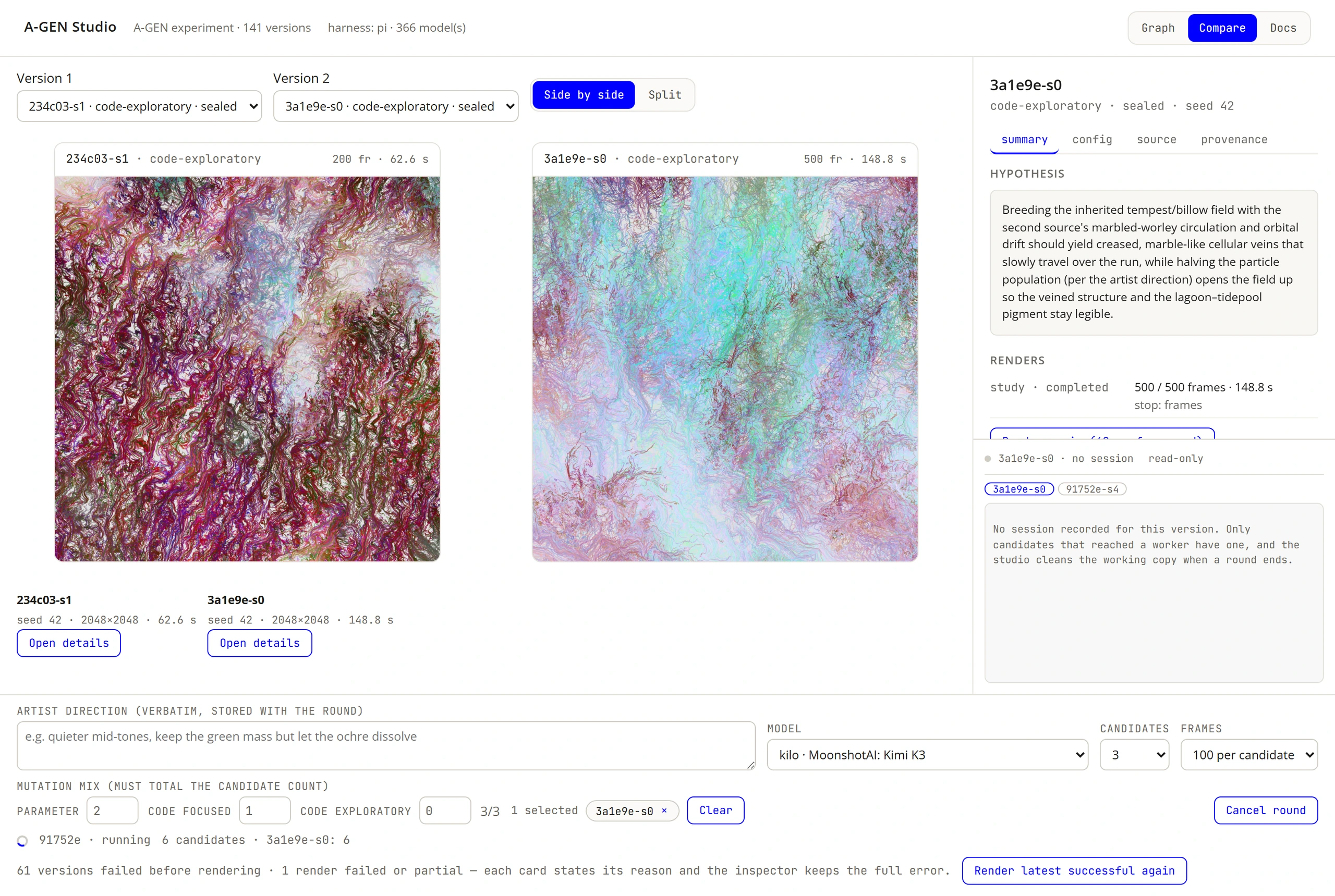
Compare view: two sealed versions side by side with frames and seconds
Fig. 6 — Frames, not durations. Two sealed versions of one seed at native resolution, each shown with the frames actually completed and the seconds it took. Unequal runs are presented as unequal rather than normalized into a fair-looking comparison, which is why a render is defined by frames and the wall clock is only a safety ceiling.
### 9 · The archive
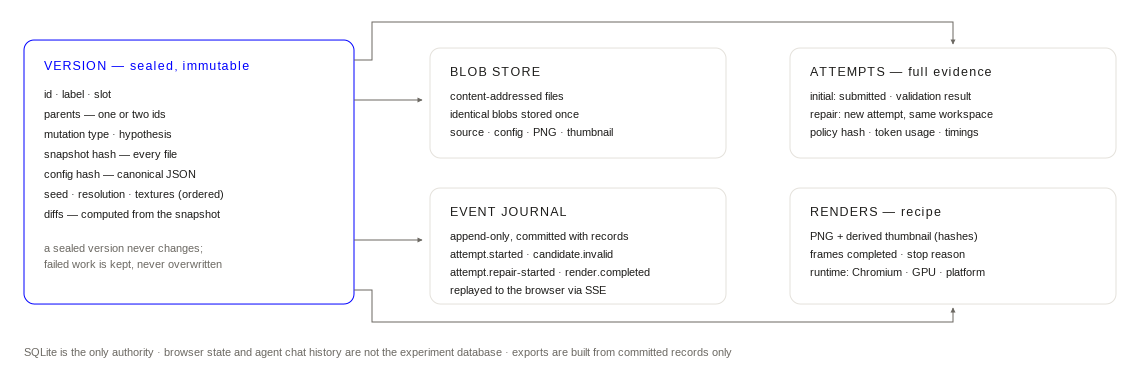
The immutable record: version, blob store, event journal, attempts, renders
Fig. 7 — The immutable record. Everything large is stored once, by hash; everything that happened is journaled; every attempt keeps its evidence. A documentation export is an offline ZIP built from this state — versions, event journal, frozen source, original PNGs.
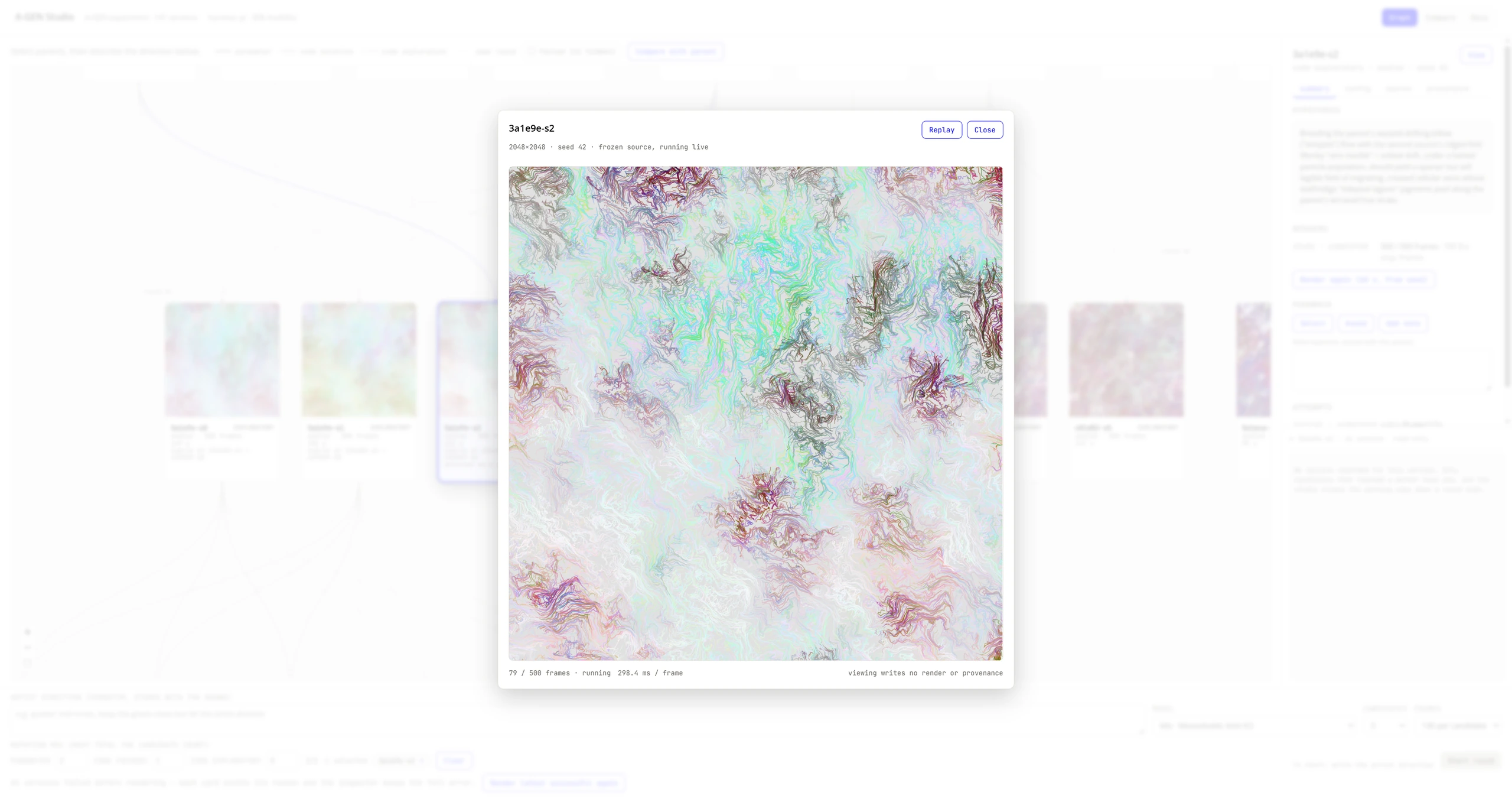
Runtime data lives outside the repository, under `%LOCALAPPDATA%\a-gen\projects\\`: `archive.sqlite`, the blob store, private agent sessions, disposable job directories, and exports. The browser's state and the agents' chat history are not the experiment database — the server's records are. ### 10 · The interface The browser is a working archive, not a chat. Three views carry the work. The **Graph** is the lineage: cards with real renders (or a hatched placeholder and an honest state), thin arrows for parentage — solid for parameter mutations, dashed for focused code mutations, dotted for explorations, faint dashes for the same-round braces. Siblings that share a parent set are grouped and centered under their parents, with a wider gap between families. **Compare** places two versions side by side at equal size with frames and seconds shown. The **Inspector** holds the summary, the config delta, the source diff, and the full provenance of one version. The bar at the bottom carries the selection, the verbatim direction, the model, and the mutation mix. With exactly one version selected, the Inspector offers **View**: the studio serves that version's frozen source from an origin of its own and the artwork plays there — not as a render, but as the artist watching the frozen code run. Watching is not work: it writes no render, event or provenance row, and the frame count in the window is measured against the length that was last recorded for that version.
The live preview window: a version's artwork playing, with its frame count and duration, over the Graph view
Fig. 8 — Live preview. One version selected in the Graph, its frozen source playing in a window of its own: a separate ephemeral origin (a different port, no CORS, framable only by this studio window), the recorded seed, and the artwork stepping its own frames with the duration per frame shown. The footer counts frames against the last recorded render and states plainly that viewing adds nothing to the record.
### 11 · Safety rules - The studio and its API are loopback-only; the browser never receives a shell or a raw agent channel. - Model output is untrusted input at every boundary — submissions are parsed, not executed. - Artwork code runs only in an isolated origin of its own — the sandboxed render Chromium, or the preview origin the studio serves to the artist's window; never in Node. - Worker tools are allowlisted by path and mode; quotas are finite; credentials stay server-side. - Cancellation is confirmed only after owned processes have actually stopped. - Failures stay visible; completed siblings are preserved; nothing is silently retried or deleted.

A-GEN_01 — human-directed evolution of a seeded noise-field painting

Documentation compiled 2026-09-14 from the running system and the repository. This page and the screenshots next to it are part of the experiment record; images are kept exactly as captured. --- # Volkswagen Group / CARIAD A camera-tracked generative installation for Volkswagen Group / CARIAD at IAA Mobility 2025 in Munich. Two overhead cameras turn visitor movement into a 14,000 × 2,000 px realtime composition across a 15 × 5.5 m LED wall and a 360° wraparound screen. ## Key facts - **Year:** 2025 - **Client:** Volkswagen Group / CARIAD - **Role:** Creative direction, generative systems, technical development - **Location:** IAA Mobility, Munich, Germany - **Tools:** Realtime Graphics, Computer Vision, TouchDesigner, Python Commissioned by CARIAD — the automotive software company of the Volkswagen Group — for the Group's Auto × Software Night at IAA Mobility 2025 in Munich, this installation transforms the Volkswagen booth into a responsive environment that reacts to the people moving through it. The system runs on a 14,000 × 2,000 pixel high-density LED wall (15 × 5.5 meters) plus a 360-degree wraparound LED screen. Two PoE cameras positioned overhead track visitor position and movement in realtime, feeding anonymized spatial data into a TouchDesigner-based generative graphics pipeline. Rather than playing back pre-rendered content, the installation generates its visuals continuously. The composition responds to crowd density, movement patterns, and dwell time — creating a living artwork that is never the same twice and that makes the boundary between observer and participant deliberately ambiguous. --- # phygen An agent-driven research environment for evolving executable artworks, with versioned code, visual feedback and an evaluation pipeline that can be inspected. ## Key facts - **Year:** 2026 - **Role:** Concept, system design, development - **Tools:** Coding Agents, Evaluation Design, Creative Tools

Independent research / System design, agent orchestration, evaluation and interface

I built phygen to explore how a coding agent can change a visual system over many iterations without losing the link between source code, rendered output and evaluation.

The starting point is a seeded physarum simulation: particles sense and deposit trails, producing a changing transport network. Agents edit its JavaScript simulation, renderer and configuration. The result is a lineage of executable programs, not a folder of generated images.
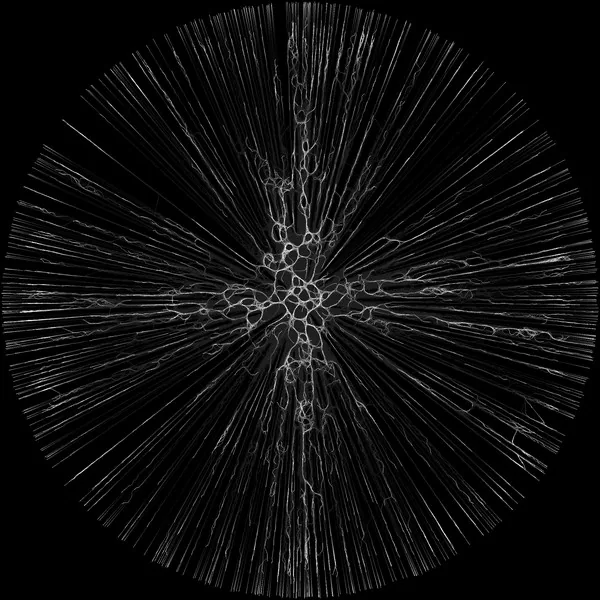
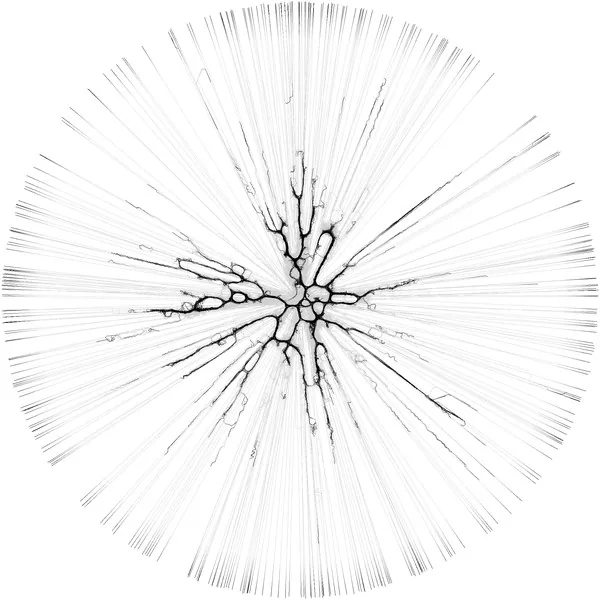
Node.js / React & TypeScript / SQLite / three.js / Playwright

Fine white trails branching from a dense central transport network against a black field
Radial transport network
Dark branching trails radiating across a white field, with fine marks gathered at the perimeter
Light-field network

Two saved versions of the simulation, with different approaches to density and contrast.

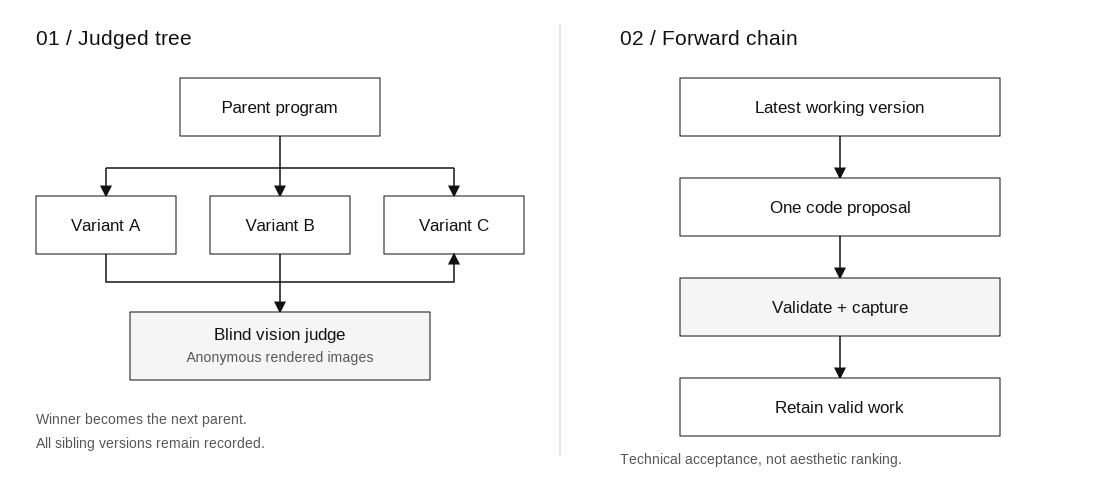
## From a judging tree to a forward chain Early iterations generated three variants per step and used a blind vision judge to rank their captures. A subsequent version added novelty thresholds and an archive for choosing parents. This exposed the central design problem: a more elaborate selection procedure was not, by itself, a better definition of artistic quality.
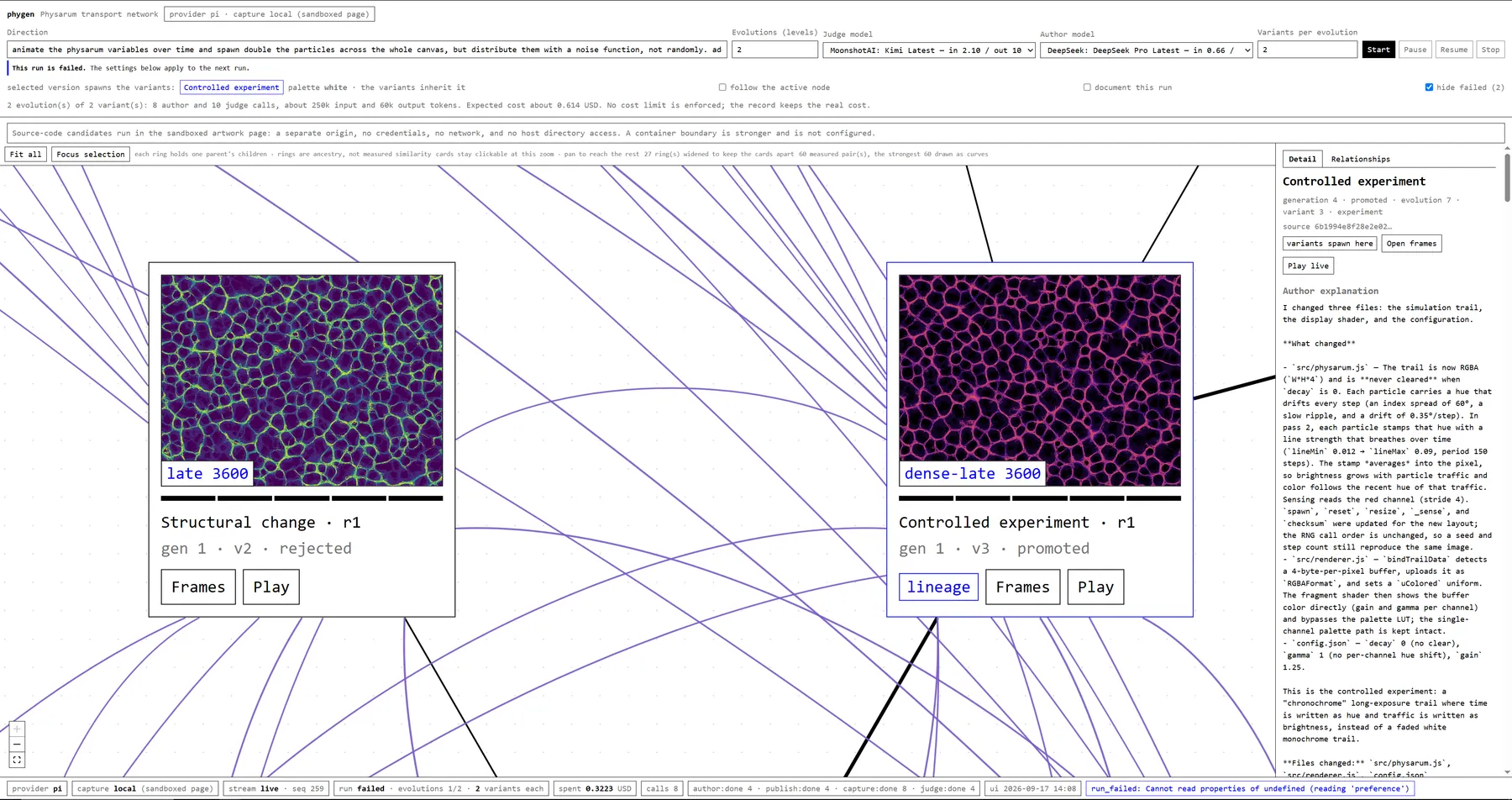
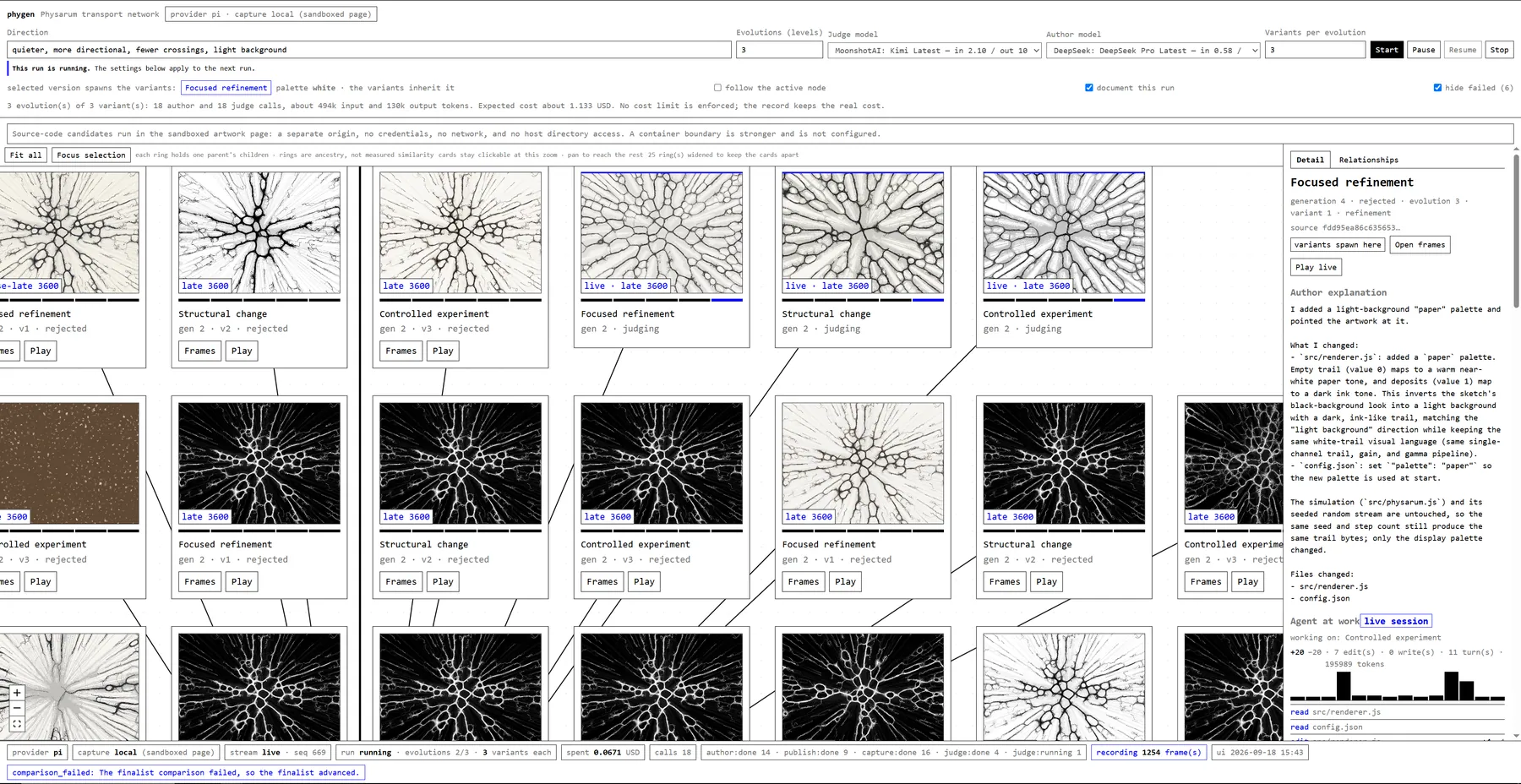
Two colored cellular network variants in the early graph interface, with the selected agent's source-change explanation in the right-hand inspector
Tree-era comparison: candidate renders and source-change explanations share one graph, so visual differences can be read alongside the agent's intent.
I then removed the ranking stage. Each step made one child of the newest working version and retained it if technical checks passed. That reduced candidate fan-out and made the history easier to follow, without treating a model's preferred image as proof of progress.
Two research iterations: three variants ranked by a vision judge, and one candidate retained after technical validation
Two research iterations, not an A/B benchmark. The forward chain removed automatic ranking; it did not guarantee aesthetic improvement. Open the diagram to inspect it.
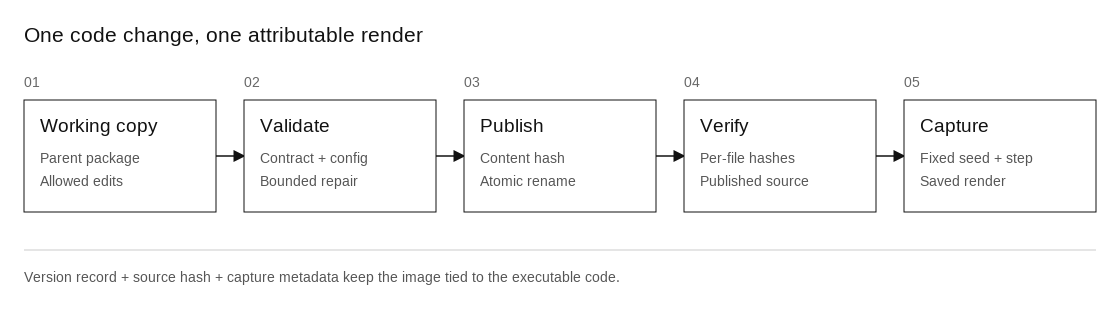
## Make every change inspectable Each step works on a copy of its parent, receives recent rendered frames, and is checked against the allowed edit surface and package contract. The controller publishes an immutable, content-addressed snapshot before rendering a fixed-seed, fixed-step sample.
A working copy passes validation, is published by content hash, is verified and then rendered under a fixed seed and step count
The capture comes from the published snapshot, not a workspace that may still be changing. Source hashes tie the visual result to the code that actually ran.
SQLite connects versions, captures, agent notes and usage. A replayable event stream exposes progress in the interface. Correctable faults get one bounded repair attempt; a failed step does not replace the last working version.
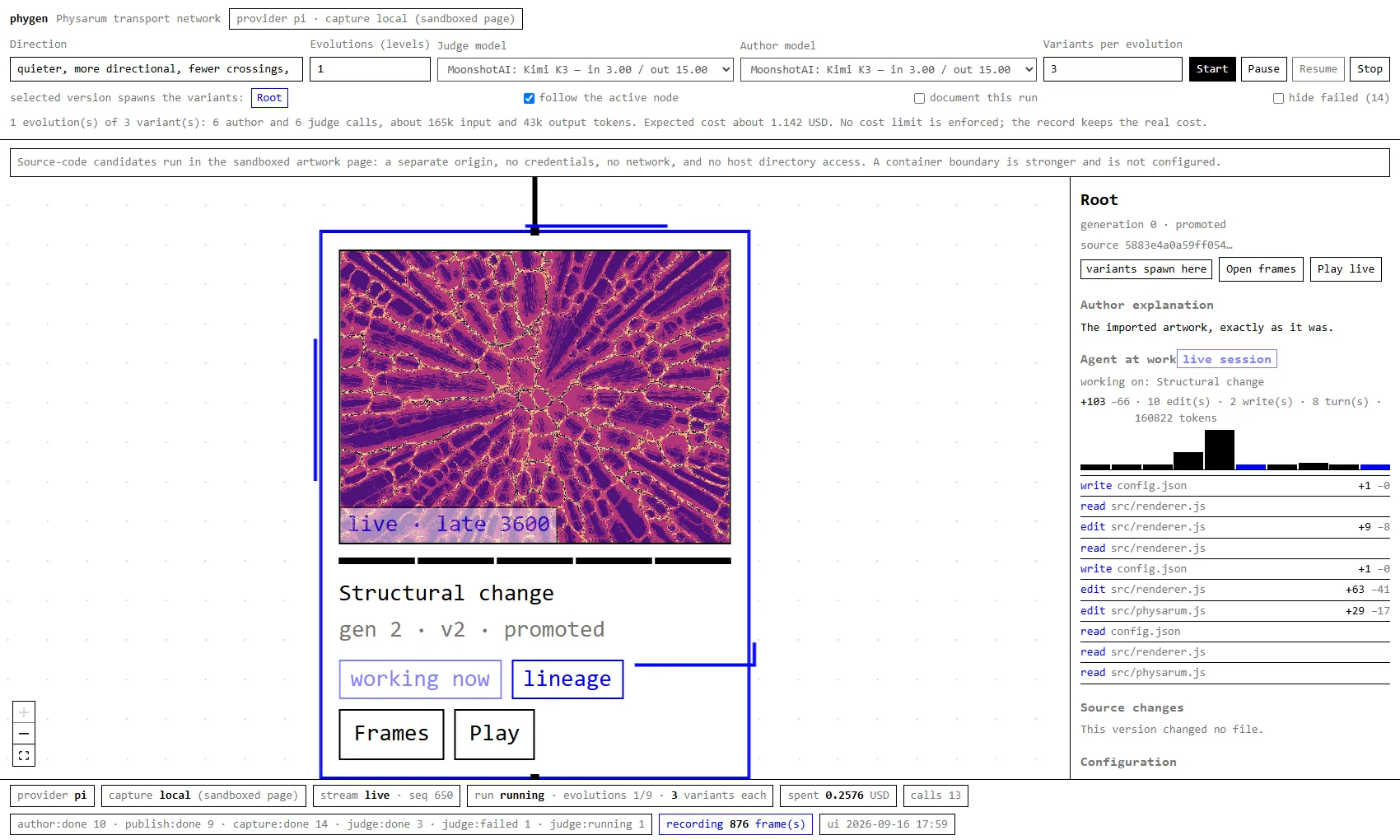
A large violet and orange network render beside a live agent feed listing file reads, edits, writes and usage counts
An early run in progress: the active render stays beside the live agent feed, file operations and usage counters.
Generated code is treated as untrusted. The browser preview uses a separate artwork origin, a script-only sandboxed iframe and a restrictive content security policy. This is a browser boundary, not a substitute for the stronger container capture mode.
An overview of captured network variants in light and dark palettes, with candidate states and an agent explanation visible in the original tree interface
Captured versions in the original tree interface. The overview makes repeated structures and changes in palette visible across a run.
## Calibrate the gate, not a claim about taste Later work added image measurements for coherence, novelty and failure diagnostics, with a blind vision judge reserved for borderline cases. Thresholds were fitted from **124 saved versions**, captured at 1024 x 1024, seed 1337, step 1000. The gate defaults to warning mode: it records verdicts without rejecting versions. Evaluation becomes a visible, adjustable layer rather than an unexamined source of authority. This calibration uses known-kept frames, not a held-out human-preference benchmark. Cross-driver image reproducibility also remains unmeasured.
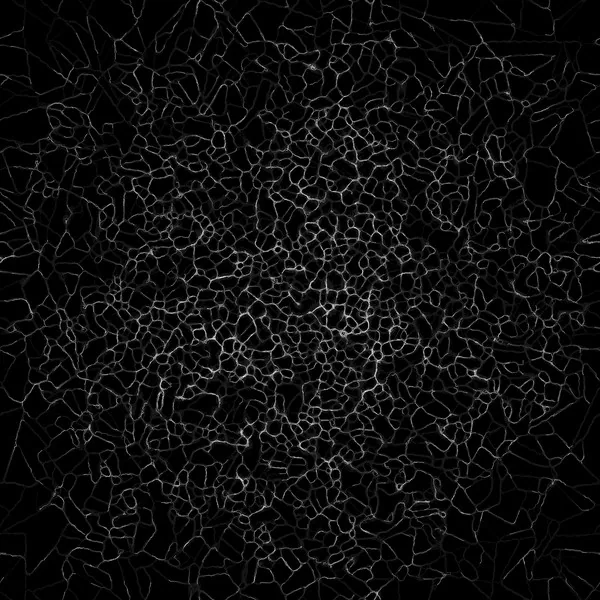
A dense web of fine gray filaments enclosing irregular cells against black
Cellular mesh
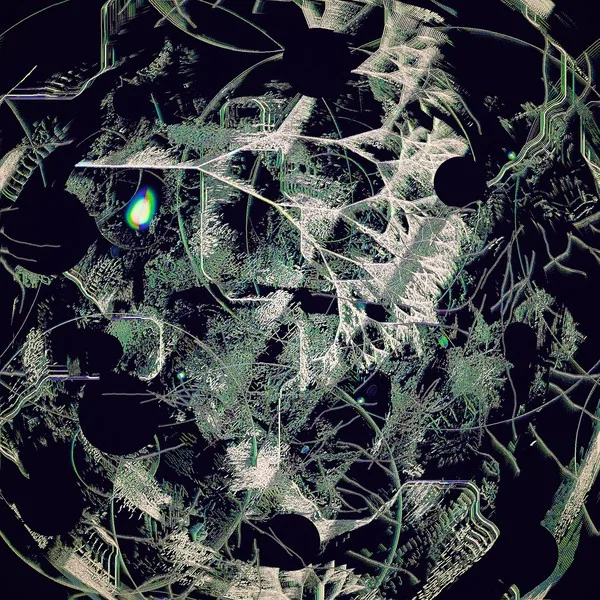
Pale green and white network fragments layered across a dark field, interrupted by open cells and a luminous green accent
Fragmented network
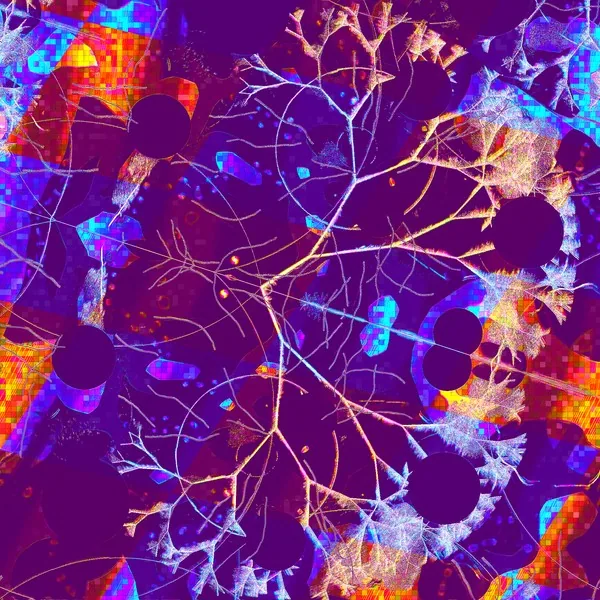
Branching white trails and luminous clusters layered over violet, red and orange fields
Layered trails
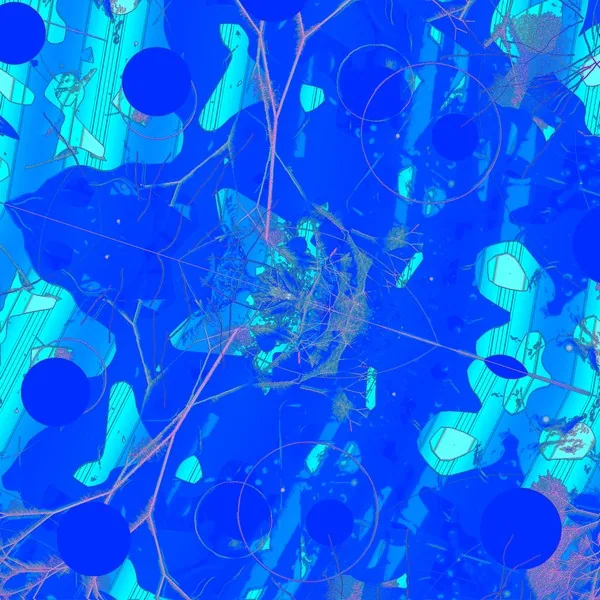
Translucent cyan and blue cellular layers crossed by fine green trails
Cyan cellular field
A blue geometric field of polygonal cells crossed by a fine yellow-green network
Geometric structure
A dense web of luminous white and cyan trails woven through angular blue, violet and pink fields
Interwoven fields

Selected saved versions show the range of the evolving program, not a ranking of artistic quality.

## What the project established The useful unit of creative agent work is not the prompt. It is the executable change together with its render, provenance, cost and failure record. phygen brings those pieces into one environment so that the system can be debugged and its evaluation choices questioned.
--- # 1275K A permanent generative media installation in the lobby of 1275K in Washington DC, running continuously since 2022. Nine audiovisual artworks rotate on a 1536 × 1750 portrait LED wall with camera-tracked interaction and realtime generative audio, managed by a self-recovering control system. ## Key facts - **Year:** 2022 - **Role:** Generative art, system design and development - **Location:** Washington DC, USA - **Tools:** Realtime Graphics, Generative Systems, Computer Vision, TouchDesigner, SuperCollider 1275K is a permanent generative media installation in the lobby of the 1275K building in Washington DC, running continuously since 2022. A single TouchDesigner system plays nine audiovisual artworks on a portrait LED wall (1536 × 1750), switching between them autonomously on a daily rhythm, generating its own soundtrack in realtime, and keeping itself alive with a self-recovering control layer. The work is not a playlist of rendered videos but a set of living systems. Each artwork is a self-contained generative scene — the GPU renders exactly one at a time at full frame rate, while the others park at zero cost. There is no pre-rendered content; everything on the wall is computed live. ## The artworks Nine generative works rotate on the wall, including a composite night state the system enters at dusk: - **Scape** — generative terrain: mountainous landscapes that are constantly regenerated, presenting new geology as the system evolves. - **Third Nature** — a virtual forest garden of digitally rendered plants that sway gently, simulating a natural setting within the lobby. - **Emergence** — the interactive piece: a camera detects people in the lobby and portrays them as digital brushes that emit multicolored particles, turning visitors into co-authors of the composition. - **Hypertecture** — an ongoing digital construction of virtual architecture: abstract sculptures forming within a constantly changing environment. - **Physarum** — a slime-mold agent simulation: thousands of agents deposit and follow trails, growing electric filament rosettes out of the black. - **Blobtracker** — the room becomes the input: tracked bodies push through the composition, and each tracked person gets a voice in the soundtrack — height maps to pitch, position to pan, size to tone. - **Fluid**, **Particlecloud**, **Nightshow** — curl-noise fluid dynamics, flocking particle fields, and the composite night state. ## Autonomy and control The installation is designed to run unattended. A scheduling layer selects artworks on a weekly rhythm and moves to a night state at dusk. A watchdog monitors the render process with a heartbeat — if the show crashes, it is relaunched automatically and the previous scene is restored. A web-based control panel allows manual override from any device on the network, with an interlock so two operators can never conflict. The entire system is built around a single principle: **state, not code**. The active artwork is one value; any component — the scheduler, the panel, the dusk timer — can write it, and the wall state is always readable. This makes the system transparent, recoverable, and extensible: new artworks can be added without touching the switching logic. --- # anymator.de A browser-based generative media product that turns professionally designed motion graphics into templates anyone can personalize and publish. Co-founded by Andreas Nicolas Fischer and deployed with hospitality and tourism clients including ROBINSON Club and TUI Cruises. ## Key facts - **Year:** 2018–ongoing - **Client:** Co-founded venture - **Role:** Co-founder · Product, creative direction, UX, generative media systems - **Location:** Berlin, Germany - **Tools:** Generative Media, Product Design, Creative Technology, FFmpeg I co-founded **anymator** to explore a simple idea: could professionally designed motion graphics become a system that anyone could personalize and publish without needing design or animation software? anymator turns animated design into a browser-based product. Users choose a template, add their own text and images, preview the result and generate a finished video that can be downloaded or shared directly through WhatsApp and social media. The consumer product is designed to remove as much friction as possible: creation happens directly in the browser, without specialist tools or production knowledge. What interested me most was the shift from **designing individual pieces of media to designing a system capable of producing them**. Motion design, typography, layout, timing and user-supplied content all have to coexist inside templates that remain visually coherent across thousands of possible inputs.
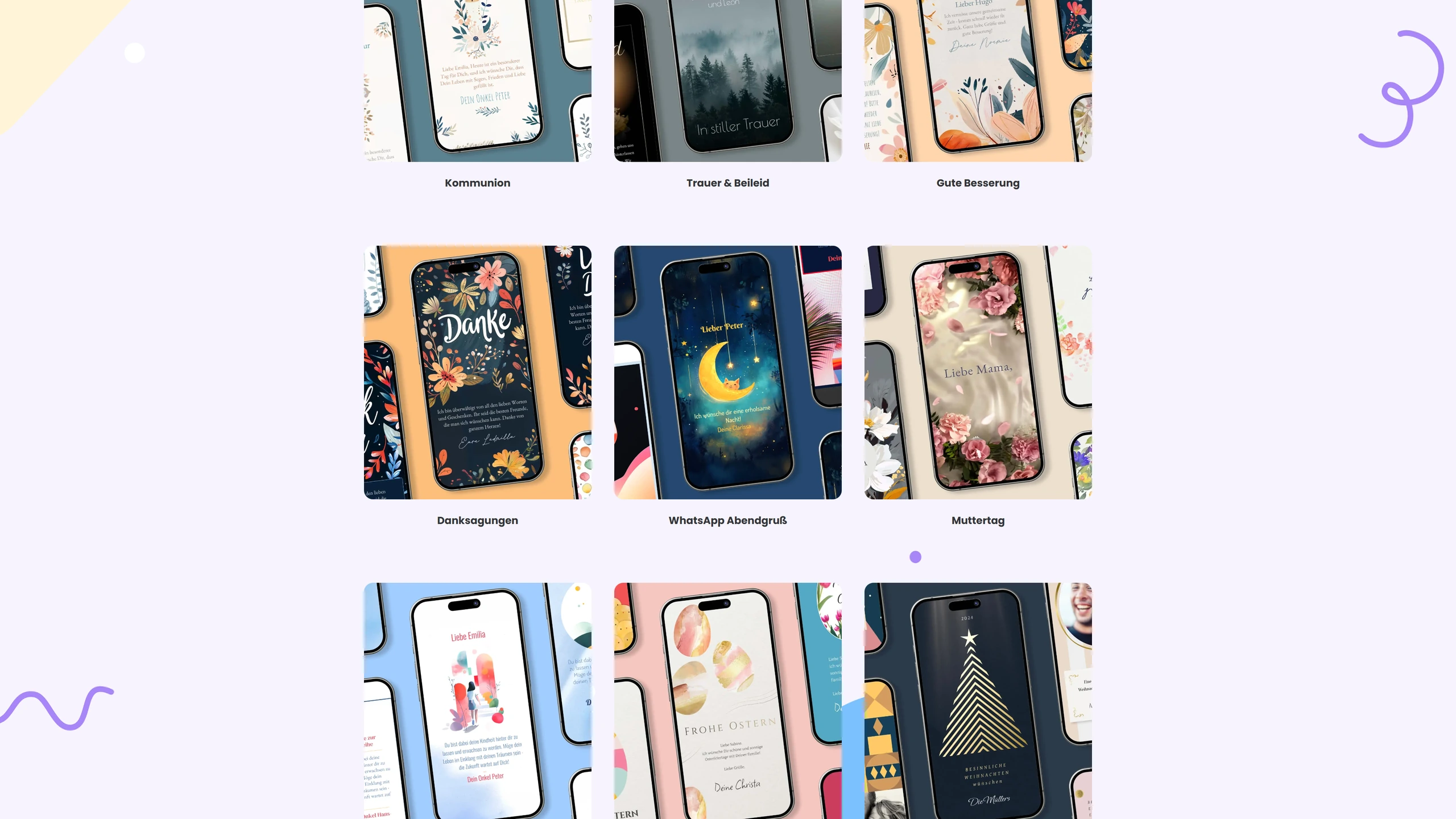
Grid of anymator template categories shown on iPhone mockups — Kommunion, Trauer & Beileid, Gute Besserung, Danksagungen, WhatsApp Abendgruß and Muttertag
The template library — occasion-based design systems (communion, condolence, get well, thanks, goodnight greetings, Mother's Day) personalized with name, message and photos
## From creative tool to product anymator developed into a complete software product rather than simply a collection of templates. The platform combines a visual editor, configurable design systems and an automated media-rendering pipeline, turning user input into finished video and image assets. This required solving problems that sit between design and engineering: how much freedom should a user have? Which decisions should remain with the designer? How can a template adapt to unpredictable text lengths and images? And how can a relatively complex rendering process feel immediate to someone using it from a phone? The public product uses a freemium model, allowing users to create content before deciding whether to purchase the finished version without anymator branding. ## B2B — turning guests into creators We subsequently developed anymator into a B2B platform for brands, tourism and hospitality. Instead of publishing another piece of branded social content, a hotel, destination or experience can give its guests a tool for creating their **own personalized branded media**. The guest combines their photograph and message with the visual identity of the destination and shares the result privately with friends and family, particularly through WhatsApp.
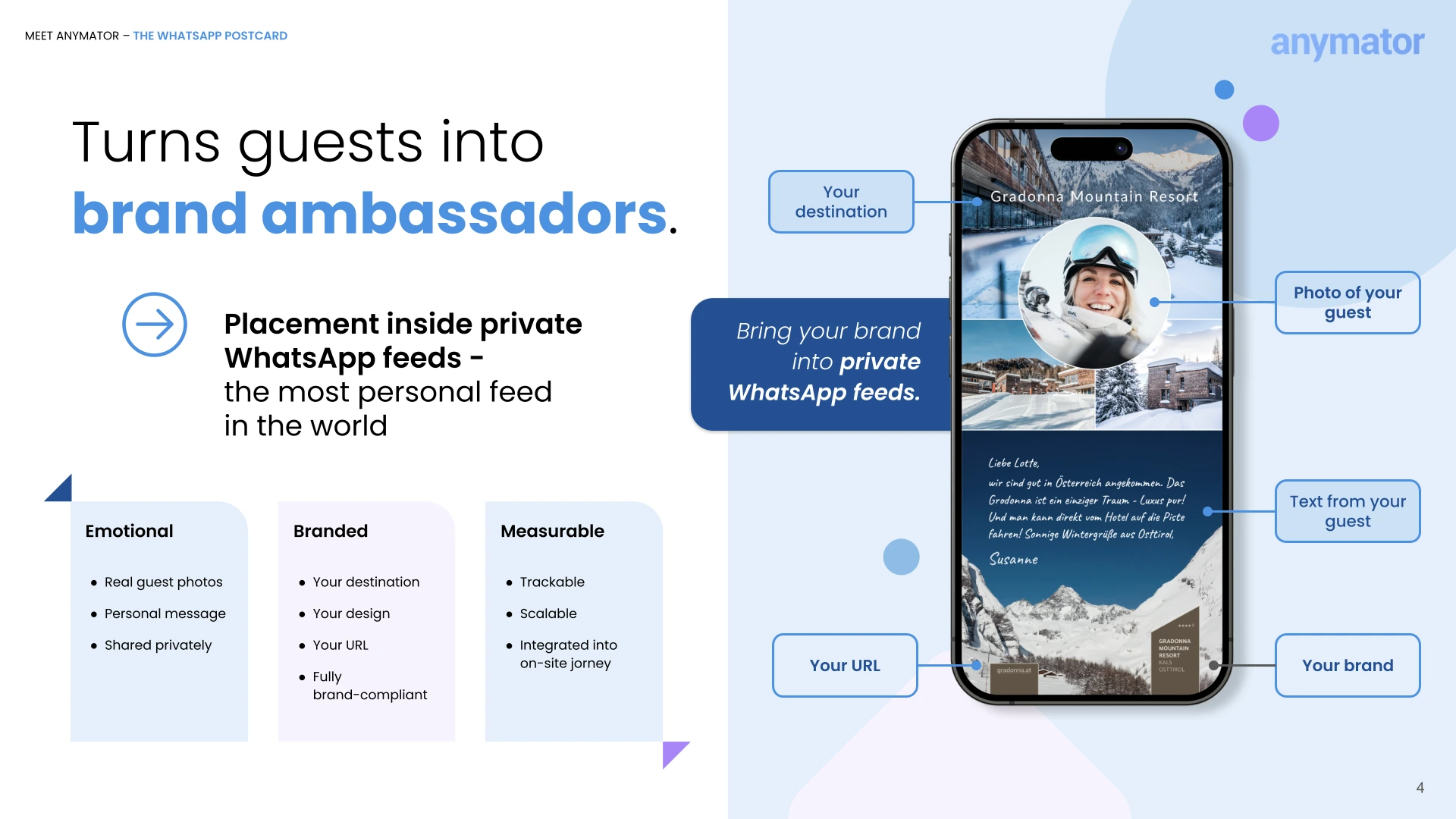
anymator B2B slide — 'Turns guests into brand ambassadors' with an annotated WhatsApp postcard mockup showing destination, guest photo, personal message, URL and brand
The B2B platform — branded WhatsApp postcards that place guests' own photos and messages inside a destination's visual identity
This creates a different relationship between brand and audience: the visitor is no longer simply consuming marketing material, but actively generating and distributing it. anymator's business platform supports branded templates, bespoke designs, personalized content at scale and integration of customized media generators into existing websites and digital products. The B2B product has been deployed with hospitality and tourism clients including **ROBINSON Club** and **TUI Cruises**, bringing personalized digital postcards and media creation directly into the guest experience.
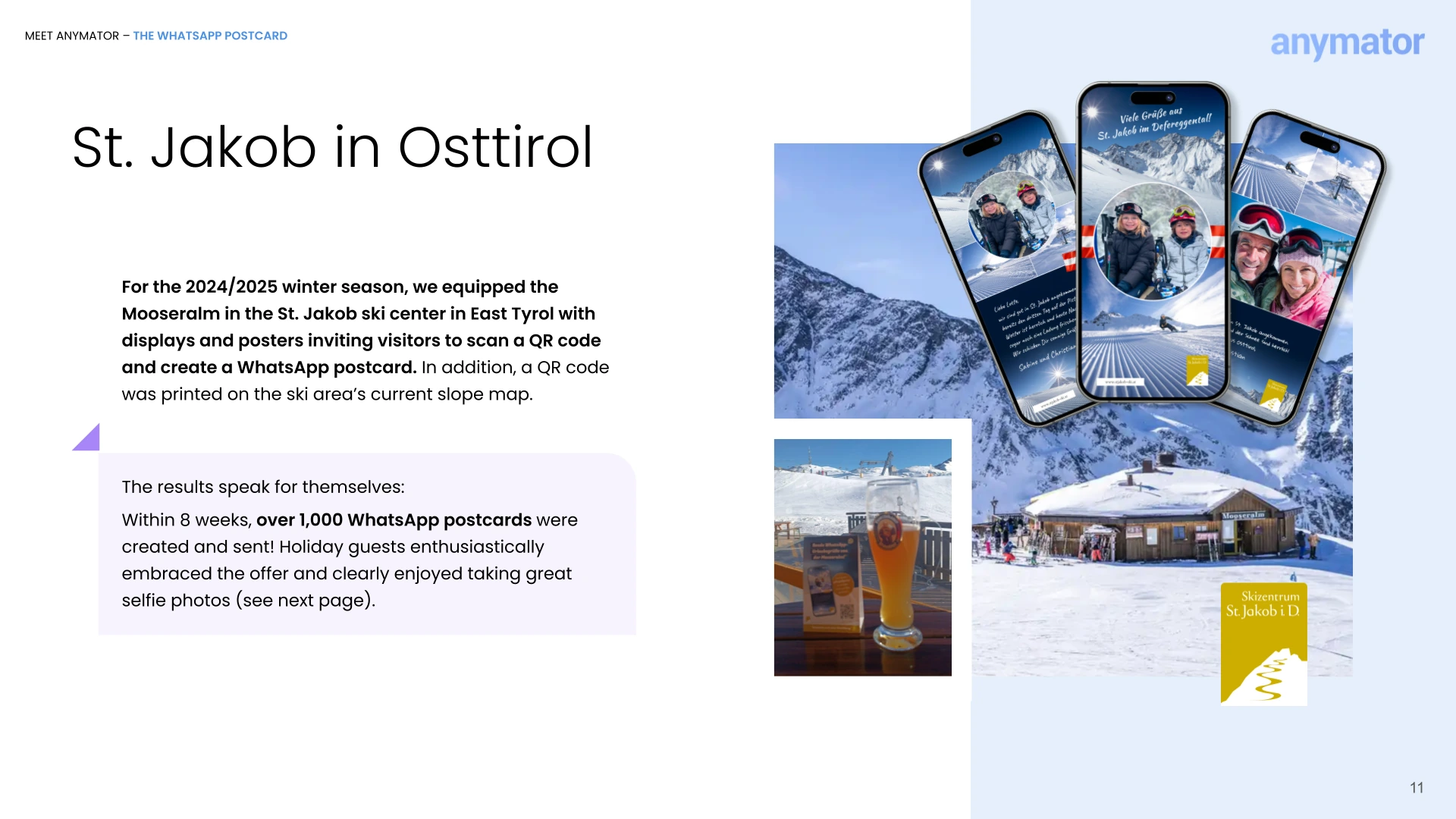
anymator case study slide — St. Jakob in Osttirol with ski area photos, postcard mockups and the result of over 1,000 WhatsApp postcards in eight weeks
Case study — St. Jakob in Osttirol, 2024/25 winter season: over 1,000 WhatsApp postcards created and sent by guests in eight weeks
## My role As a co-founder, my work spans **product concept, creative direction, UX, generative media systems and the technical architecture of the content pipeline**. anymator has also been an ongoing exercise in product development: watching how real users interact with a creative system, removing unnecessary complexity, testing business models and adapting the product to very different consumer and enterprise contexts. More recently, we have been exploring how AI can change the editor itself — moving from fixed customization toward systems that can assist with composition, content creation and adaptation while retaining the underlying design logic. For me, anymator represents an important transition in my work: **from creating generative experiences myself to building tools that allow other people to create with them.** [anymator.de](https://anymator.de/en)